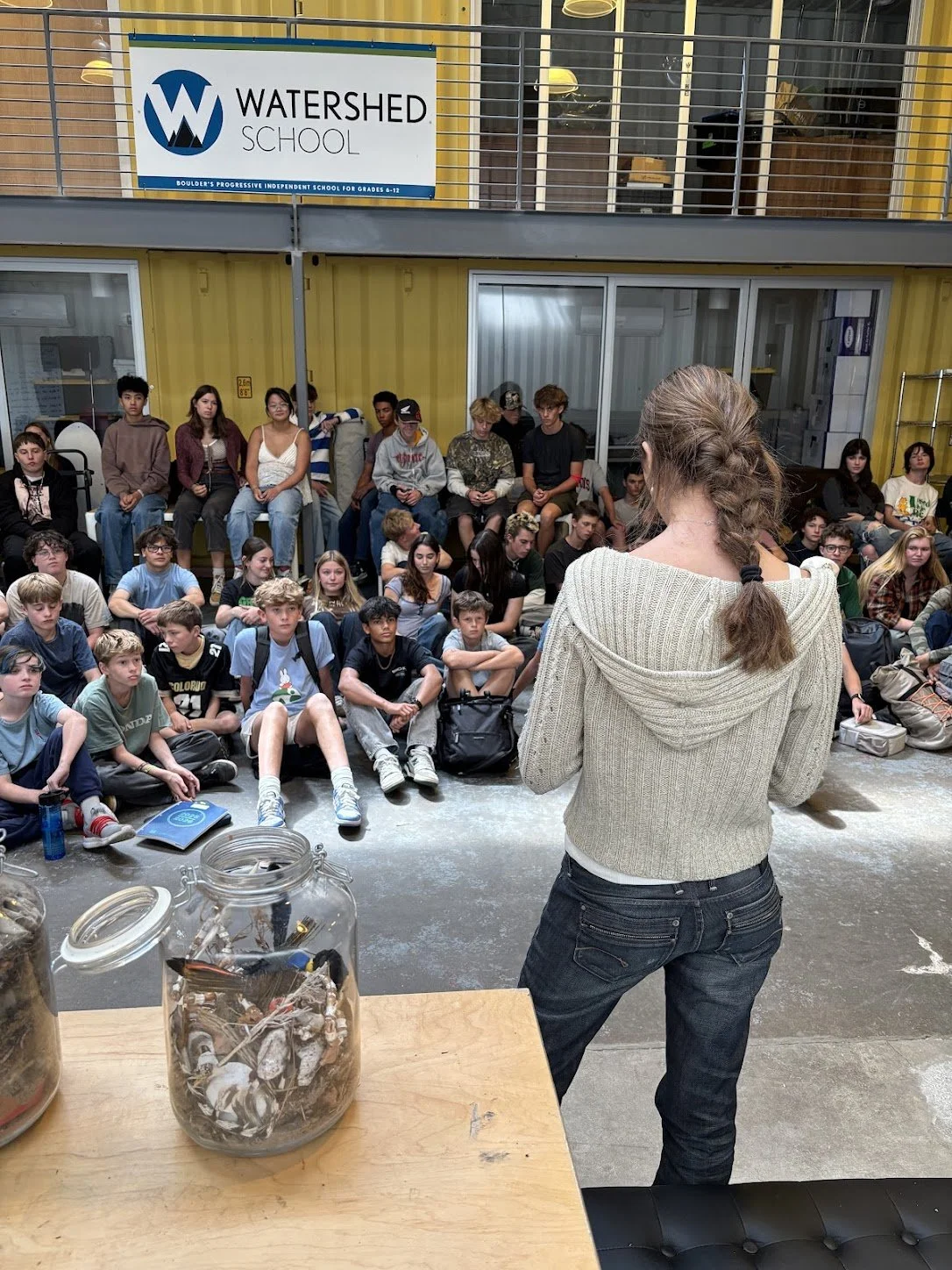
An incoming parent shared this article with us, noting how closely it aligns with the Watershed approach. It reflects on the transition to college and the mix of excitement, pressure, and identity shifts that accompany it. More broadly, it invites reflection on how we prepare young people not only for academic next steps, but for life beyond them - something deeply connected to Watershed’s focus on hands-on learning, growing independence, and meaningful real-world experience. We hope you enjoy the article as much as we did!
What parents should actually be encouraging their kid to do next year...
A few weeks ago I found myself back on the Bowdoin College campus for an alumni panel on AI and the future of work, sitting across from a room full of students who were trying to figure out what the next few years were going to look like for them.
Before the panel, over dinner with faculty and career counselors and a handful of students, I kept hearing a version of the same anxiety: the world is changing faster than anyone can track, the jobs that seemed safe a few years ago don’t feel safe anymore, and the question of whether four years of a liberal arts education is the right preparation for what comes next was sitting in the room like an uninvited guest.
Walking between buildings that evening, I recognized the feeling. It is the same one I hear from parents of college-bound kids all the time, and one I have felt myself: in a world moving this fast, is breadth a luxury students can afford? Wouldn’t a more specialized, pre-professional curriculum be the safer bet?
I have come to believe that instinct, while completely understandable, is asking exactly the wrong question, and that most of the conventional wisdom guiding parents through this decision right now is optimized for a labor market that is already changing underneath us.
The Path That Used to Work Is Narrowing
For most of the last fifty years, the deal was implicit but durable. You got your kid into a good school, they worked hard, they graduated, and a large institution absorbed them. The analyst class at McKinsey or Goldman, research analyst at a major university or government body, the rotational program at a Fortune 500, these organizations took in thousands of talented junior people every year and did the work of turning them into professionals. They provided structure, mentorship, credentials, and a clear ladder. Many of those kids went on to graduate school before the real ascent began, but the point was that the large entity was the on-ramp, and the on-ramp was reliable.
That on-ramp is narrowing, and parents sending kids to college today deserve to understand why.
The work that once required a class of twenty-five analysts, most of it research, synthesis, first-draft document production, data modeling, and structured problem-solving, can increasingly be handled by a much smaller team equipped with AI. This is not a prediction about some distant future. It is already showing up in hiring numbers, in shrinking analyst cohorts, and in the quiet restructuring of what entry-level roles are actually expected to do. The competition for those spots is intensifying at exactly the moment the developmental scaffolding they used to provide is thinning out. Your kid may get the job, but it will not look the way you remember jobs looking, and it will not develop them the way you were developed.
The students who will navigate this well are not the ones who optimized hardest for those shrinking spots. They are the ones who started preparing for a different kind of territory.
The Other Thing That Happened
At exactly the same moment that the large-institution path is contracting, something else has occurred that most career conversations aimed at college students, and the parents advising them, have not yet absorbed.
The cost of building something from scratch has collapsed.
A company, a nonprofit, a research initiative, a service that matters to a community that has been underserved, any of these things used to require years of accumulated credibility, a network of connections, and enough capital to hire a team. Your kid would have needed to wait until they were senior enough to have resources, or until they had saved enough to take a real risk, or until they had spent a decade inside an organization learning how things worked before they could try anything independently. The team that once required a seed round and eighteen months of recruiting is now available for the cost of a few software subscriptions. Marketing, engineering, research, strategy, communications, finance, all of it, ready to deploy this afternoon on whatever problem your kid actually cares about.
No generation in history has had access to this before theirs.
Which means the question for your graduating senior is no longer only which large organization will hire them and develop them. It is also, for the first time, what do they want to build, and what is actually stopping them from starting? If they care about rural education, chronic disease, climate resilience, democratic participation, or any of the other problems that have historically been too underfunded or too daunting for a small team to tackle, they no longer need to find a billionaire philanthropist or wait until they have enough seniority to matter. They can start now, with the team they already have.
The Two Ways to Think About AI
There is a mindset question underneath all of this that I have started to think is the most important thing a parent can help their kid internalize before they graduate.
There are two fundamentally different ways to relate to AI. The first is that AI is the thing coming to replace you, in which case every new model release is a threat, every capability announcement is a reason for fresh anxiety, and your entire orientation is defensive.
The second is that AI is your superpower, a set of capabilities that multiplies what you can do by an order of magnitude, in which case every new model release is a reason to celebrate, because your team just got more powerful. The difference between these two orientations is not optimism versus pessimism. It is the difference between thinking like an employee and thinking like and in many cases becoming an owner and chief executive, and the students who come out of college with the owner orientation are going to have a fundamentally different experience of the next decade than the ones who didn’t.
Your job as a parent is not to teach them the tools. The tools will change completely between now and graduation, and whatever prompt engineering course they take as freshmen will be quaint by senior year. Your job is to help them develop the orientation underneath the tools.
What Actually Prepares Them
This brings me back to that campus, and why I now think the anxiety about breadth versus specialization has it exactly backwards.
The skills that determine whether AI makes someone exceptional or merely efficient are not technical. I have written about them at length here on the Raising Humanity substack, but the short version is this: critical thinking, strategic judgment, the ability to communicate clearly and persuasively, and the capacity to lead other people through uncertainty. These are the skills that determine whether someone treats AI as a genuine thought partner, pushes back on its reasoning, brings real context and judgment to bear, and produces work that actually changes something, or whether they take the first output, call it done, and wonder why their work looks the same as everyone else’s.
I watch this divergence inside my own corporate Silicon Valley job every day. Give two people the exact same AI tools on the exact same problem, and they produce work products that are not even close in quality. The difference is never the tool. It is whether the person on the other end of the conversation has the judgment to know what good looks like, the curiosity to keep pulling on the thread, and the critical thinking to recognize when the AI has gone confidently off a cliff. That judgment layer is not something you can learn in six months. It accumulates through years of struggling with hard problems, defending positions out loud, having your thinking pushed back on by someone who knows more than you, and being forced to synthesize across disciplines in ways that don’t have clean answers.
Which is, not coincidentally, a fairly accurate description of four years at a rigorous liberal arts college.
There is also a concern worth addressing directly, because I hear it from parents and from students themselves. If AI is doing so much of the work, how does someone build real judgment? Aren’t we screwing over the future leaders by not training them the old way? If you never had to struggle through the problem the hard way, do you ever develop the instincts that struggling produces?
It is a serious question with a genuinely counterintuitive answer. Consider what a product manager’s first two years might look like now compared to mine. In my early years, I shipped a handful of products. The cycle times were long, the organizational friction was real, and each launch was a months-long ordeal. A junior PM today, working with AI-assisted workflows, might ship ten times that volume in the same period, which means ten launches, ten rounds of user reactions, ten post-mortems, ten sets of patterns deposited into their accumulating sense of judgment. Lewis Hamilton did not become the driver he is because he understood every component of the engine at a mechanical level. He became who he is because he drove more tracks, in more conditions, more times than almost anyone else. The reps are not gone for your kid’s generation. They are multiplied.
The Practical Advice
So what should you actually be encouraging your kid to do while they’re there?
Go broad. The student who takes economics and philosophy and environmental science and statistics and a writing seminar is not diluting their preparation. They are building the cross-domain pattern recognition that allows them to see connections that specialists miss, and that AI cannot manufacture on its own.
Go deep in something. Breadth without at least one area of genuine depth produces generalists who lack the judgment to know when they’re out of their depth. The independent research project, the thesis, the thing they pursued beyond the assignment because they couldn’t stop thinking about it, this is what produces the kind of curiosity that separates people who use AI to discover interesting problems from people who use it to produce slightly faster versions of mediocre work.
Lead things with real teams. Not just join organizations, but take on roles where they are responsible for other people, where their judgment affects outcomes for a group, where they have to communicate a vision and bring skeptical people along. The seminar teaches them to think. Leading the student organization teaches them to move people. Both matter, and the second one is considerably harder to develop later than the first.
The students who come out of college with all three of these in their toolkit are the ones who will look at that team of AI agents and know exactly what to do with them. The ones who spent four years optimizing for a credential, picking the most legible major and the most prestigious-sounding internship and the most predictable path, will find that the path they optimized for has fewer spots than it used to, and that they skipped the development that would have made them formidable anywhere else.
Congrats, your kid is going to college. What they do with it matters more now than it ever has.
Tom Leung is a Director of Product Management at Meta, a volunteer part-time instructor at Foothill College, a student advisor at Stanford GSB and UC Berkeley Skydeck, and a Bowdoin College and Harvard Business School alumnus. He is also the father of two boys navigating the education system in real time. Raising Humanity is where he thinks out loud about what it actually takes to prepare the next generation for a world that keeps changing the rules.
*The source article can be found here.